Dive Meet 101
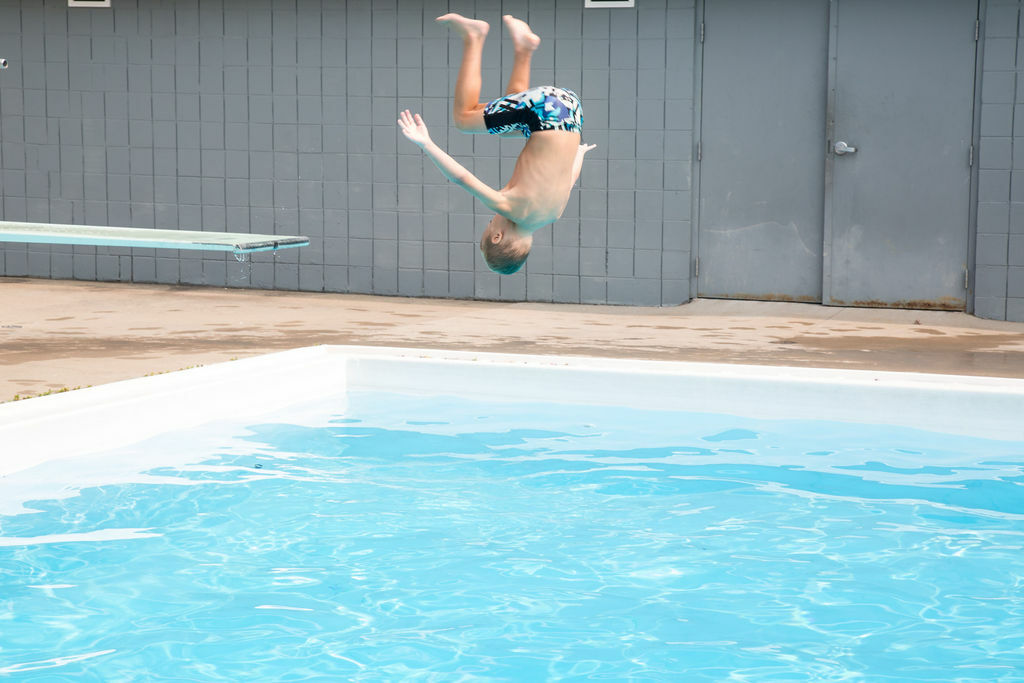


Dive meets begin at 4:00. Warmups begin at 3:00 for the home team and 3:30 for the away team.
Judging:
When Judging diving – the Overall Impression of the dive is the most important thing. There are three parts to every dive.
They are:
1. The approach/hurdle ~ smooth and graceful is what we want.
2. The takeoff and the flight of the dive “the higher, the better” along with a safe distance from the board (good parabola of the dive in the air)
3. The entry into the water ~ vertical is what we want.
These are the three things a good judge should be looking for. All dives are scored in half point increments from 0-10 points. A ten (10) does NOT mean perfect – it means EXCELLENT. A “0” means the dive is completely Failed.
There are five categories in diving: The forward group, the back group, the reverse group, the inward group, and a twisting group. Whenever you add a twist to any of the four groups it then belongs in the twisting group. All dives must be performed in a declared position: tuck, pike, straight or free position. Free position is only for twisting categories. A required dive is simply a dive from one of the five categories. An optional dive is something a little fancier than a dive; for example, a front flip or a back 1½ somersaults. As the children get older, the dive requirements get harder.
Awarding points:
10 Excellent/Wow/Amazing in all ways
8.5 to 9.5 Great to Very Good
7 to 8 Good/Solid/better than ok
5-6.5 Satisfactory/okay/mediocre
2.5 to 4.5 Deficient/flawed
.5 to 2 Unsatisfactory, almost a fail
0 Failed
*disclaimer: Judge 8&U like 8&U; 15&18 like 15&18, etc. but you don’t judge 8&U like 15&18’s or 15&18’s like Olympians.
Starting position:
1. Stand up straight
2. Head erect.
3. Arms held straight at a position of the diver’s choice
Keep in Mind:
1. “The higher, the better.”
2. Safe Distance
3. Compact tucks and pikes
4. Good form – legs straight, feet together, and toes pointed.
5. The approach can be any number of steps including a standing takeoff.
5. The Hurdle must be FROM ONE FOOT and LAND ON TWO FEET.
6. Entry – VERTICAL with least amount of splash is best
TERMS to KNOW:
Balk – After assuming the starting position, the diver makes an obvious attempt to start the approach or press down and then stops. The Referee should announce that 2 points should be deducted from the scores given after the diver completes the re-dive. (NOTE: Two balks on the same dive is a Failed Dive).
Crow Hop – on Back of Inward dives where the diver while rocking the diving board lifts their feet from the board before actually leaving the board. Crow hops are extremely dangerous so a deduction should be made. (deduct ½ to 2 points)
Cutie points – Are unfair; judge the dive – not the diver.
Degree of Difficulty (also known as “DD”): Judge the dive – not the difficulty of the dive.
Failed dives determined by the Referee – The following reasons make a failed dive:
1. The diver performs a dive – other than what is announced
2. A diver Balks twice (on the same dive)
3. On a head first dive, the feet contact the water before the hands - for example,
in a 1 ½ somersault the feet hit the water before the hands.
4. On a feet first dive, any other body part contacts the water first - for example,
in a front flip the butt hits the water first instead of the feet
5. On a twist dive, the diver does greater or less than 90 degrees of what is announced – 180 degrees equal a half twist
6. The diver falls off the board into the water
7. The diver receives assistance or spotting (in our league, they must be exhibition) no spotting in the Champ Meet
8. The diver refuses to execute the dive
9. The diver takes off from the Springboard with one foot
10. If the diver takes more than one bounce (double bounce) NOTE: A Double Bounce is different than a Crow Hop.
11. A diver takes more than one minute to execute the dive. (After a warning given by the Referee)
A diver can only earn a 4 ½ MAX if they:
1. enter the water with their hands above the shoulders on a feet first entry
2. enter the water with one or both hands below the shoulders on a head first dive
3. the diver performs a dive that is PARTIALLY in a position other than what is announced – slightly bent knees in a pike or bent at the waist in a layout are good examples of this.
A diver can only earn 2 points MAX if the diver performs a dive CLEARLY in a position that is different from what is announced. Always check the dive sheet with the announcer. (Example – dive announced is 103B and the diver does 103C)
If the diver hits the board (example: divers hits heels on a back dive) - judges deduct according to individual opinion but there should be a deduction.
As a judge, be as fair as possible. Do not play favorites. “A good diver is capable of doing a bad dive just as a less accomplished diver is capable of performing a good dive.”
Do the very best you can. You will make mistakes. The more you judge, the better your judging will become.
Thank you for taking the time to learn more about judging. Do remember, discretion should be used with how stringently the rules are applied and enforced - especially with young divers, exhibition divers and early in the dive season at dual meets. Always give the benefit of the doubt to the diver. This is Summer Club Diving!